
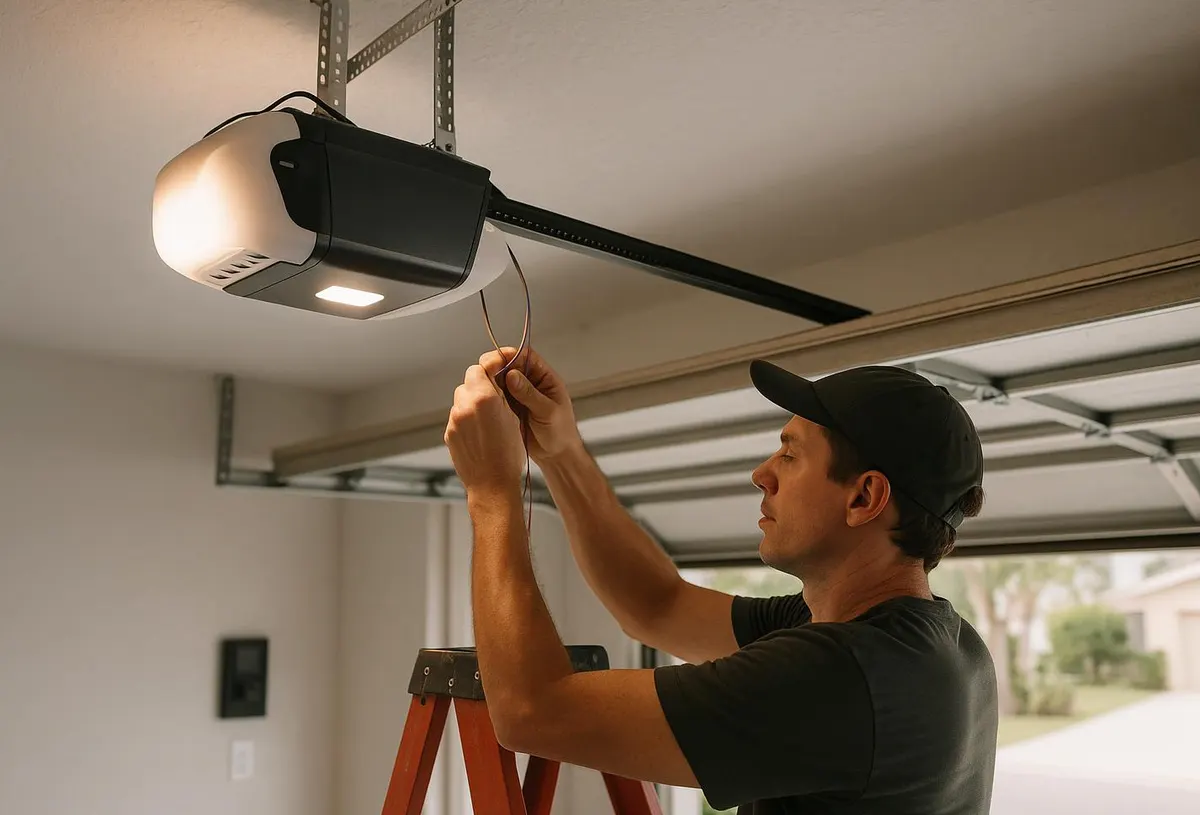
Skip this for another season and the cost isn't a bigger repair bill — it's a door that closes on a car bumper, a bicycle, a pet, or worse, and doesn't know to stop. Photo-eye sensors are a small, cheap, overlooked part of the system, and when homeowners ignore them (or disable them out of frustration), they're removing the one safety feature standing between a 150-plus pound door and whatever happens to be underneath it when it closes.
What These Sensors Actually Do
Every garage door opener made since the mid-1990s has two small boxes mounted a few inches off the garage floor, one on each side of the track. They send an invisible infrared beam across the opening. If the beam breaks while the door is closing, the opener reverses the door instead of letting it keep coming down. No beam, no safety stop. That's the whole system — simple, but only as good as its alignment and cleanliness.
Why They Trip or Fail in This Part of Alabama
Springville's climate is hard on this particular part of the door system for a few specific reasons:
- Humidity and moisture swelling: Wood and composite door frames can swell slightly during long humid stretches, which shifts the mounting brackets just enough to knock the sensors out of alignment.
- Afternoon downpours: Wind-driven rain gets into garages through the bottom seal and splashes dirt and grit onto the sensor lenses, especially on doors that face the direction storms usually come from.
- Rust on brackets and screws: Moisture that sits in the garage after a storm corrodes the small metal brackets holding the sensors in place, and once a bracket rusts, it loosens and the sensor drifts out of alignment over time.
- Direct sunlight: A low afternoon sun angle shining straight into a sensor lens can wash out the infrared beam, causing the door to reverse for no obvious reason even when nothing is actually blocking it.
- Spiders and insects: Garages near tree lines and open fields get webs and bugs that settle right on the lens and block the beam intermittently.
How Badly This Goes Wrong
A misaligned or dirty sensor usually shows up first as an annoyance — the door won't close, or it closes partway and reverses. That's the system working correctly and telling you something is wrong. The real danger starts when a homeowner gets tired of the inconvenience and disables the sensors entirely, either by unplugging them or holding down the wall button to force the door shut manually. At that point, the door has no way to detect a car, a child's bike, a pet, or a person underneath it. Garage doors are heavy enough to cause serious injury or worse, and that's exactly the scenario these sensors exist to prevent. A door that won't close because of a dirty lens is a five-minute fix. A door that closes on something because the sensors were bypassed is not something you get a second chance to prevent.
How to Clean and Align Them Correctly
- Power down first. Unplug the opener or switch off the breaker before touching any wiring or brackets.
- Wipe both lenses with a soft, dry cloth or a cloth lightly dampened with water — no household glass cleaner, which can leave a film that scatters the beam.
- Check the indicator lights. Most sensors have a small LED that glows solid when properly aligned and blinks or stays off when it isn't. Both sensors should show a steady light at the same time.
- Loosen the wing nut or mounting screw and gently adjust the angle until both lights are solid, then retighten.
- Inspect the brackets for rust or looseness. If a bracket is corroded through, it needs to be replaced, not just re-tightened, or it will drift again within weeks.
- Check the wiring running along the track for chew marks or moisture damage, especially if rodents have been active in the garage.
- Test monthly by waving a broom handle through the beam while the door is closing — it should reverse immediately. If it doesn't, stop using the door until it's fixed.
When Not to Bypass Them — Even Temporarily
It's tempting to hold the wall button to force a stubborn door shut when you're in a hurry, especially during a storm when you just want the garage sealed up. Don't make this a habit. A door that closes on manual override has zero obstruction detection, and in a household with kids, pets, or anyone pulling in and out during heavy rain with limited visibility, that's a real risk. If the sensors are consistently unreliable, the fix is proper realignment or replacement — national parts typically run in the $15–$40 range for the sensor pair — not disabling the safety feature altogether.
When to Call Springville Garage Door
If you've cleaned and aligned the sensors and the door still won't close reliably, or if you're seeing rust on the brackets or exposed wiring, it's time for a technician rather than more trial and error. Our garage door repair service covers sensor diagnosis, bracket replacement, and wiring checks so the safety system actually works the way it's supposed to. If it's been more than a year since anyone looked at the full system, our preventive maintenance visits catch sensor drift, rust, and corrosion before they turn into a door that won't close — or worse, one that closes when it shouldn't.
Don't wait for a near-miss to take care of this. Call Springville Garage Door today and let's make sure your garage door is actually safe to use, not just convenient.